
written by Jeannine Baetz, M.A. (University of Galway, SLLC)
Listen to the full episode on Spotify
In this episode of B.A.B.E.L. in Galway - A podcast about languages, cultures, and lives across borders, hosts Dr. Bianca Cataldi and Dr. Andrea Ciribuco (University of Galway, School of Languages, Literatures and Cultures) are joined by Dr. Tina-Karen Pusse (University of Galway, School of Languages, Literatures and Cultures) and Dr. Michaela Schrage-Früh (University of Limerick, Centre for European Studies) to discuss their DAAD1-funded research project “European Societal Challenges in German Culture: Exploring Ageing and Climate Change in Tandem”.
Ecocriticism and ageing studies as interdisciplinary fields
How can literary research lead to interest in the environment, health, and ageing? For Tina, the poetry of Rainer Maria Rilke (specifically, the cycle of poems entitled “Sonnets to Orpheus”) played a special role as a turning point in her understanding of ecocriticism and its potential. She also emphasises the impact of Timothy Morton’s writing on ecocriticism as a key theoretical framework that that has helped her put into perspective the ‘othering2’ of nature in environmental discourses:
“You put [nature] on a pedestal, you adore it from afar, but you are constantly othering it, are violent towards it”.
Poetry has played a similar role in Michaela’s path towards ageing studies: citing the poetry of Eavan Boland as an influential example, Michaela addresses a shift in perspective in the field of ageing studies from narratives of ageing that centre loss and decline (“the horror of ageing”) towards narratives that frame ageing as a process of gaining wisdom and life experience. When discussing the increasing interdisciplinary collaboration between the fields of ecocriticism and ageing studies, Michaela identifies the process of othering (at its core a process of social exclusion) as a particularly poignant contact zone between both fields and notes an equivalency between the othering of the ageing body and the othering of nature.
Generation narratives in environmental discourses
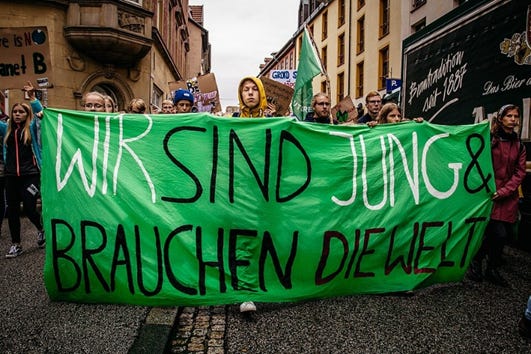
A common thread linking the fields of ecocriticism and ageing studies that is brought up in this episode is that of generational narratives (Generationennarrative) and generational conflicts. Drawing on the example of the COVID-19 pandemic (specifically, the Irish government’s strategy of encouraging the “cocooning” of people over the age of 65 during lockdowns), Michaela and Tina discuss the frequent framing of the elderly as both frail and powerless, but also as the guilty parties in public health and climate change discourses.
“There’s this misconception today that we [GenX] grew up in some really pristine ecologically intact world, and we simply squandered it.”
Following Andrea’s observation that narratives about generational conflicts in climate change discourse – a particularly common topic in US-American contexts – constitute an overgeneralisation in most contexts, Tina goes on to highlight both past environmental crises during her youth (such as air pollution in West German mining towns) and successful outcomes of climate activism of the past (e.g. regarding the ozone layer, or the passing of anti-nuclear legislation in Germany).
In this context, Tina argues, Timothy Morton’s concept of “hyperobjects” proves a useful framework for approaching the topic: while climate change in itself is too large to grasp, its concrete effects (such as health consequences) are both hyperlocal and material, and thereby offer a productive starting point for climate activism.
Ecocriticism and ageing studies as fields for interdisciplinary and intergenerational cooperation
A recurring theme in this episode is the entwined and interdisciplinary nature of both ageing studies and ecocriticism, with a repeated emphasis on an alienation from nature and the ageing body as a central point of overlap between both fields.
At the end of the episode, Bianca takes up Tina’s earlier point about societal alienation from nature and asks the two guests for their advice to younger listeners looking to delve deeper into the academic and activist sides of ecocriticism and ageing studies.
Here, Tina and Andrea discuss the example of photography to highlight how the (perceived) separation between humans and nature is (unconsciously) perpetuated even at the level of social media: landscapes are represented as isolated, untouched places (often through the careful cropping out of human elements like cars or street signs), and the negative environmental impacts of mass tourism are increasingly turning into an often-ignored side effect of natural environments being dubbed “instagrammable” locations. On that basis, Tina advises a reframing of humanity’s relationship to nature as a symbiotic, cooperative relationship.
Michaela similarly stresses the importance of solidarity and cooperation, rather than ‘othering’ nature and the ageing body by drawing on the example of the German Sci-fi/mystery series Dark (2017-2020)3: in the series, the inhabitants of a small town are trapped in a closed loop of intersecting timelines and travel back and forth in time, often working against younger or older versions of themselves to prevent future or past actions. As can be concluded from this microcosm of generational conflicts, Michaela argues, narratives about generational conflicts in ecocriticism and ageing studies are ultimately counterproductive as a way of facing the rapidly progressing climate crisis, as opposed to intergenerational solidarity.
Concluding remarks and keywords
As in the last episode, the two guests are asked to come up with a key word in a language other than English to sum up a particularly relevant aspect of their research.
Tina chooses the German word “Mitwelt” (social environment) and argues that it is more productive than the more commonly used term “Umwelt” (environment) as it emphasises a shared community with humans and nonhuman life over an anthropocentric understanding of nature as an ‘other’ that surrounds us4.
Circling back to the topic of ageing and climate activism, Michaela selects the German word “Generationengerechtigkeit” (intergenerational justice/justice for all generations) – a term that encompasses justice in terms of quality of life, resources, and social/political participation – and stresses the application of its scope to both currently living generations and future generations.
The DAAD-funded research project “European Societal Challenges in German Culture: Exploring Ageing and Climate Change in Tandem” is organised by the Universities of Galway and Limerick and aims to shine a spotlight on entangled representations of ageing and climate change in German-language culture(s) in a European context. More information about the project and upcoming events can be found on the official project website .
Literature recommendations
Balestrini, Nassim, et al., editors. Aging Studies and Ecocriticism: Interdisciplinary Encounters. 1st ed. Lexington Books, 2023.
Carrington, Leonora. The Hearing Trumpet. 1974. With an introduction by Ali Smith. Penguin Books, 2005. Modern Classics.
Morton, Timothy. Being Ecological. The MIT Press, 2018.
Nagamatsu, Sequoia. How High We Go in the Dark. Bloomsbury Publishing, 2022.
Additional literature:
Durastanti, Claudia. La straniera. 4th edition. La nave di Teseo, 2019.
Morton, Timothy. Dark Ecology: For a Logic of Future Coexistence. Columbia University Press, 2016.
Deutscher Akademischer Austauschdienst/German Academic Exchange Service
A concept first coined by literary scholar Gayatri Chakravorty Spivak in reference to postcolonial discourses, ‘othering’ has been taken up in the fields of literary studies and postcolonial studies to refer to systematic processes of framing an individual or group as an (inferior and often voiceless) ‘other’ in contrast to the dominant social group and excluded from discourses, power, and/or social participation (cf. Spivak’s essay Can the Subaltern Speak (1985), later published in Patrick Williams and Laura Chrisman’s edited volume Colonial Discourse and Post-Colonial Theory in 1994. See also Gingrich, Andre. “Othering.” Lexikon der Globalisierung, edited by Fernand Kreff et al., transcript Verlag, 2011, pp. 323–24. Global Studies).
Tina and Michaela have explored connections between environmental concerns and ageing in Dark in: Pusse, Tina-Karen, and Michaela Schrage-Früh. “Time Travel, Age/ing and Ecology in the German Netflix Series Dark (2017-2020).” Aging Studies and Ecocriticism, edited by Nassim W. Balestrini et al., Lexington Books, 2023.
While both terms can be translated as “environment”, the difference between the prefixes “um-” and “mit-” is difficult to accurately convey in English. “Umwelt” here carries the connotation of something peripheral (“um” is commonly translated as “around”), whereas the “mit” (with, together) in “Mitwelt” underlines the notion of a cooperative, collaborative environment.